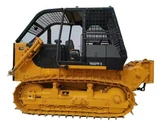
As a supplier of 320hp Rock Type Bulldozers, I've witnessed firsthand the remarkable capabilities of these powerful machines when it comes to handling different rock densities. In this blog post, I'll delve into the technical aspects of how our 320hp Rock Type Bulldozers tackle various rock densities, providing insights based on real - world experience and scientific understanding.
Understanding Rock Densities
Rock density is a crucial factor that determines the difficulty of excavation and movement. It is typically measured in grams per cubic centimeter (g/cm³) or kilograms per cubic meter (kg/m³). Different types of rocks have varying densities due to their mineral composition, porosity, and geological formation.
For instance, granite, a common igneous rock, has a density ranging from 2.6 - 2.7 g/cm³. Limestone, a sedimentary rock, has a density between 2.2 - 2.7 g/cm³, depending on its purity and porosity. Basalt, another igneous rock, is denser, with a density of about 2.8 - 3.0 g/cm³. The higher the density of the rock, the more force is required to break, move, and displace it.
Key Features of 320hp Rock Type Bulldozers
Our 320hp Rock Type Bulldozers are specifically engineered to handle the challenges posed by different rock densities. The 320 - horsepower engine provides a significant amount of power, which is essential for breaking through and moving dense rocks. This high - powered engine is designed to deliver consistent torque, enabling the bulldozer to maintain its performance even under heavy loads.
The blade of the bulldozer is another critical component. It is made of high - strength steel that can withstand the impact and abrasion caused by contact with rocks. The shape of the blade is optimized to maximize the force applied to the rocks, whether it's for pushing, lifting, or breaking them. Additionally, the blade can be adjusted hydraulically, allowing operators to adapt to different working conditions and rock formations.
The undercarriage of the bulldozer is also built to handle the rough terrain and heavy loads associated with rock - handling operations. The tracks are designed to provide excellent traction, ensuring that the bulldozer can move steadily on uneven surfaces. The suspension system helps to absorb shocks and vibrations, reducing wear and tear on the machine and providing a more comfortable working environment for the operator.
Handling Low - Density Rocks
When dealing with low - density rocks such as some types of limestone, the 320hp Rock Type Bulldozer can operate relatively efficiently. The lower density means that less force is required to move the rocks. The bulldozer can use its blade to push the rocks aside or stack them in a designated area.
The high - powered engine allows the bulldozer to move at a reasonable speed, increasing productivity. The hydraulic system that controls the blade can be adjusted to apply just the right amount of force, preventing unnecessary wear on the blade and the machine. In this case, the bulldozer can be used for tasks such as clearing the site of loose rocks or preparing the ground for further construction.
Handling Medium - Density Rocks
Medium - density rocks, like granite, present a greater challenge. The 320hp engine comes into its own here, as it can generate enough force to break through the rocks. The operator can use the blade to apply pressure to the rocks, gradually breaking them into smaller pieces. Once the rocks are broken, the bulldozer can then push and move them.
The hydraulic system allows for precise control of the blade, which is crucial when dealing with medium - density rocks. The operator can adjust the angle and height of the blade to target specific areas of the rock, increasing the efficiency of the breaking process. The undercarriage's traction and stability also play an important role, as the bulldozer needs to maintain its position while applying force to the rocks.
Handling High - Density Rocks
High - density rocks, such as basalt, are the most difficult to handle. The 320hp Rock Type Bulldozer may need to work in conjunction with other equipment, such as rock breakers, to break the rocks into manageable sizes. The high - powered engine provides the necessary force to move the broken rocks, but the initial breaking process can be time - consuming and requires careful planning.
The blade of the bulldozer needs to be in excellent condition to withstand the extreme forces involved. The operator must use the blade strategically, applying force in a way that maximizes the breaking effect. The undercarriage's durability is also crucial, as the bulldozer may need to make multiple passes over the rocks to move them effectively.
Comparison with Other Bulldozers
In comparison to 220hp Forest Logging Bulldozer, our 320hp Rock Type Bulldozers are more powerful and better suited for rock - handling operations. The 220hp bulldozer is designed primarily for forest logging, where the focus is on moving logs and clearing vegetation. While it can handle some light - duty rock work, it lacks the power and specialized features required for handling high - density rocks.
Mud and Swamp Dedicated Bulldozers are optimized for working in soft, wet conditions. Their design emphasizes flotation and traction in mud and swampy areas. These bulldozers are not built to handle the high - impact forces associated with rock - handling operations.


Coal Mine Bulldozers are designed for the specific requirements of coal mining, such as moving coal and overburden. While they may have some similarities in terms of power and durability, our 320hp Rock Type Bulldozers are more specialized for handling a wide range of rock densities, with features specifically tailored to the challenges of rock - breaking and moving.
Real - World Applications
Our 320hp Rock Type Bulldozers have been used in various real - world applications, including quarrying, mining, and large - scale construction projects. In quarrying operations, the bulldozers are used to break and move large rocks into crushers for further processing. In mining, they are used to clear the overburden and expose the ore - bearing rocks. In construction, they are used to prepare the foundation by removing rocks and leveling the ground.
Importance of Operator Skills
While the 320hp Rock Type Bulldozer is a powerful and capable machine, the skills of the operator also play a crucial role in handling different rock densities. An experienced operator can make the most of the bulldozer's features, such as adjusting the blade angle, controlling the speed, and applying the right amount of force. They can also identify the best approach for dealing with different rock formations, which can significantly improve the efficiency and safety of the operation.
Conclusion
In conclusion, our 320hp Rock Type Bulldozers are well - equipped to handle different rock densities. Their high - powered engine, robust blade, and durable undercarriage make them suitable for a wide range of rock - handling applications. Whether it's low - density limestone or high - density basalt, these bulldozers can perform effectively, providing reliable and efficient rock - moving solutions.
If you are in need of a bulldozer for rock - handling operations, we invite you to contact us for a detailed discussion about your requirements. Our team of experts is ready to assist you in choosing the right equipment and providing you with the support you need for a successful project.
References
- "Engineering Geology" by Arthur W. Rose, Jack C. Hunt, and David L. Fitzpatrick.
- "Bulldozer Operation and Maintenance Manual" (Internal company document).
- "Rock Mechanics Principles" by E. Hoek and E. T. Brown.