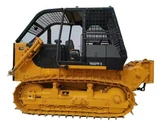
As a supplier of crawler bulldozers, I've witnessed firsthand the impressive capabilities and widespread applications of these remarkable machines. In this blog post, I'll delve into the working principle of a crawler bulldozer, exploring its key components and how they work together to perform heavy - duty tasks.
The Basics of a Crawler Bulldozer
A crawler bulldozer is a powerful construction machine designed for earth - moving, grading, and leveling operations. The crawler design, with its continuous tracks, provides excellent traction and stability on various terrains, including soft soil, mud, and uneven ground.
1. The Engine
The heart of a crawler bulldozer is its engine. Modern crawler bulldozers are typically equipped with diesel engines due to their high torque output and fuel efficiency. The engine generates the power needed to drive the various components of the bulldozer. It converts the chemical energy in diesel fuel into mechanical energy through a series of combustion processes.
The engine's power is transmitted to the transmission system. This is crucial because the bulldozer needs sufficient power to push large amounts of earth, rocks, or other materials. The size and power of the engine depend on the model and intended use of the bulldozer. For instance, a smaller bulldozer used for light - duty tasks may have a less powerful engine, while a large - scale industrial bulldozer requires a high - power engine to handle heavy loads.
2. The Transmission System
The transmission system of a crawler bulldozer plays a vital role in controlling the speed and direction of the machine. There are two main types of transmissions commonly used in crawler bulldozers: mechanical and hydrostatic.
Mechanical transmissions use a series of gears to transfer power from the engine to the tracks. They are known for their durability and simplicity. The operator can shift gears manually to adjust the speed and torque according to the task at hand. However, they require more skill to operate, especially when changing gears frequently.
Hydrostatic transmissions, on the other hand, use hydraulic fluid to transfer power. They offer smoother operation and easier control. The operator can control the speed and direction of the bulldozer with a single lever, making it more user - friendly. This type of transmission is often found in modern, high - end crawler bulldozers.
3. The Crawler Tracks
The crawler tracks are one of the most distinctive features of a crawler bulldozer. They consist of a series of metal links connected in a continuous loop. The tracks are driven by sprockets, which are connected to the transmission system.
The design of the crawler tracks provides several advantages. Firstly, they distribute the weight of the bulldozer over a large area, reducing the ground pressure. This allows the bulldozer to operate on soft or unstable ground without sinking. Secondly, the tracks offer excellent traction, enabling the bulldozer to move forward, backward, and turn even on slippery surfaces.
The tracks can also be adjusted to suit different terrains. For example, in muddy or wet conditions, wider tracks can be used to increase the contact area and improve stability. In rocky or uneven terrains, tracks with more aggressive tread patterns can be employed to enhance traction.
4. The Blade
The blade is the working attachment of the crawler bulldozer. It is located at the front of the machine and is used to push, lift, and move materials. There are different types of blades available, including straight blades, U - blades, and semi - U blades.
Straight blades are the most common type. They are simple and effective for general earth - moving tasks. U - blades have a curved shape, which allows them to carry more material and are suitable for large - scale pushing operations. Semi - U blades combine the features of straight and U - blades, offering a balance between capacity and maneuverability.
The blade is controlled by a hydraulic system. The operator can raise, lower, tilt, and angle the blade using hydraulic cylinders. This precise control allows the bulldozer to perform a variety of tasks, such as grading, leveling, and back - filling.
How It All Works Together
When the operator starts the engine, the power is generated and transmitted to the transmission system. The operator then selects the appropriate speed and direction using the controls of the transmission.
As the power is transferred to the sprockets, the crawler tracks start to move. The bulldozer can then be driven forward or backward. When the operator wants to perform a pushing task, they lower the blade to the ground using the hydraulic controls.
The blade comes into contact with the material, and the power from the engine and the traction provided by the tracks allow the bulldozer to push the material forward. The operator can adjust the angle and tilt of the blade to control the flow and amount of material being pushed.
During the operation, the hydraulic system continuously adjusts the position of the blade to ensure smooth and efficient work. The transmission system also adjusts the speed and torque according to the load on the bulldozer.
Our Product Range
At our company, we offer a wide range of crawler bulldozers to meet different customer needs. For example, our Crawler Type Wetland Bulldozer is specifically designed for wet and soft terrains. It has a special track design and a powerful engine to ensure stable operation in these challenging conditions.
Our 160hp Standard Type Crawler Bulldozer is a versatile machine suitable for a variety of earth - moving tasks. It offers a good balance between power and cost - effectiveness.
If you need a high - performance bulldozer for large - scale projects, our Power Shift Large Crawler Dozer is an excellent choice. It has a powerful engine and an advanced power - shift transmission system for smooth and efficient operation.


Contact Us for Procurement
If you are interested in our crawler bulldozers or have any questions about their working principles, applications, or specifications, please feel free to contact us. We have a team of experts who can provide you with detailed information and help you choose the most suitable bulldozer for your project.
References
- "Construction Equipment Handbook" by Frank R. Walker
- "Principles of Heavy Equipment" by Peter L. Nicholson
- Manufacturer's manuals of various crawler bulldozer models